
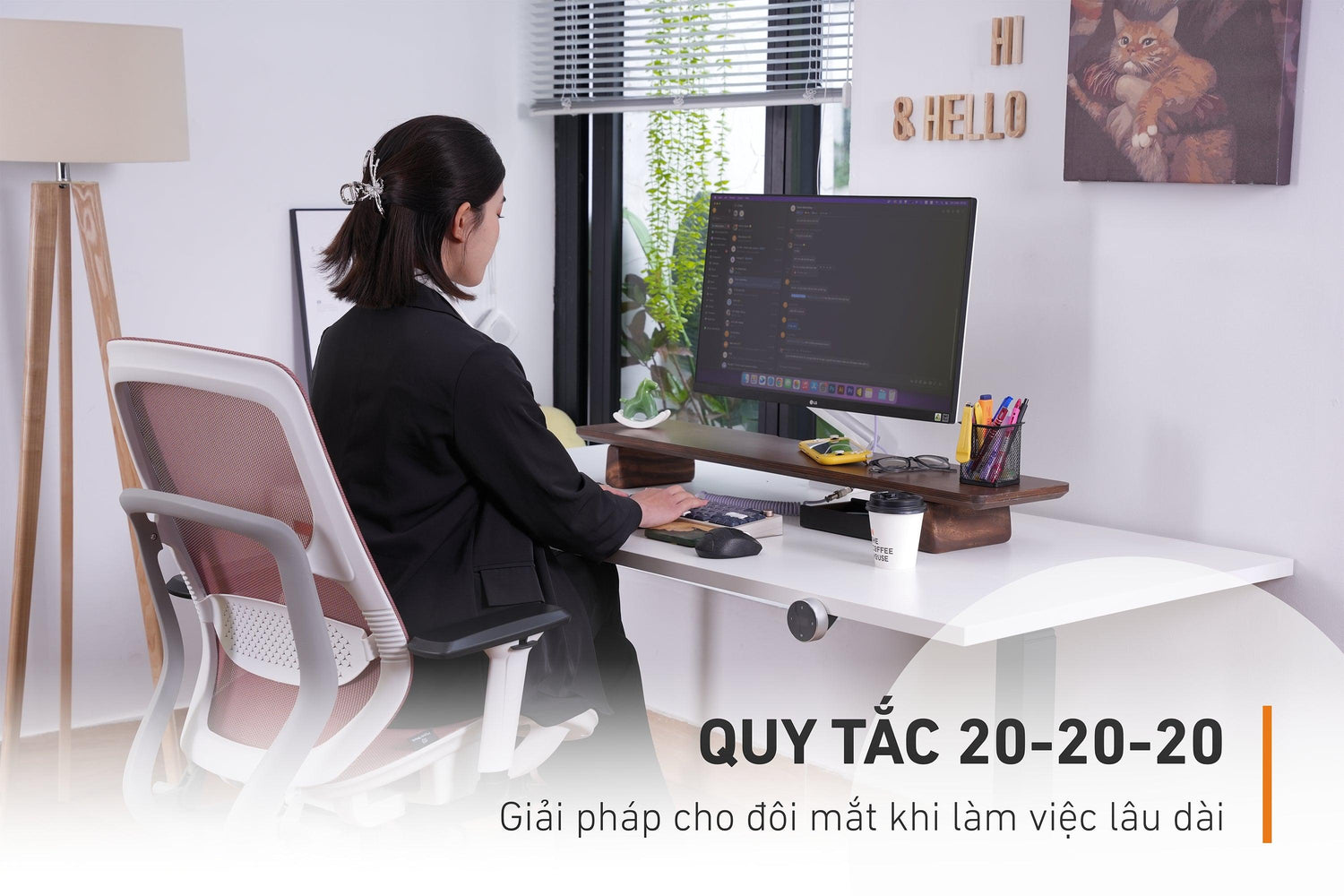
The 20-20-20 rule was created by an American ophthalmologist to help people who frequently work with electronic screens better protect their vision.
People who work frequently with computers, such as office workers (8-9 hours/day), freelancers (many hours on projects), technical staff (many hours on duty in various day-night conditions), etc., often experience eye and vision problems. In Vietnam, approximately 4-6 million people suffer from dry eyes to varying degrees, and 60% of office workers have eye diseases (according to VTV).
Given this alarming situation, office workers can equip themselves with some easy-to-implement solutions to protect their eyes, including the 20-20-20 rule.
1. What is the 20-20-20 rule?
This rule proposes a solution: Every 20 minutes of looking at an electronic screen, you should stop and look at a point about 20 feet (approximately 6.1 m) away for 20 seconds.
2. How to apply the 20-20-20 rule
The 20-second break is just enough for your eyes to rest without significantly affecting or interrupting your work.
Conversely, each 20-second break will refresh your eyes, helping you maintain high concentration while working. Instead of worrying that these 20 seconds will be wasted, you can avoid fatigue and strain from constantly looking at a screen with harmful blue light.
The 20 seconds can be counted manually, and the 20-minute intervals can be reminded by an alarm clock. Meanwhile, how do you measure the 20-foot distance, equivalent to 6.1 m? If you can accurately define a distance of 6.1 m, that's ideal. However, if you can't estimate, allow your eyes to look far away at any point in the office (doorway, opposite desk row, filing cabinet, plants, hallway, mini-bar, etc.)

In today's fast-paced, dynamic office environment, it can be difficult to find the time or remember to follow this rule.
Moreover, the 20-20-20 rule is not a comprehensive method to prevent all eye problems (as there are many other causes such as individual constitution, working hours, poor quality computer screens, etc.). However, it is still a manual method recommended by many doctors if you have a specific job involving electronic devices.

Additionally, office workers should also pay attention to creating a suitable working environment: combining natural and artificial light, using standard lamps with moderate power, and limiting glare that causes eye strain and blurred vision.
HyperWork has researched and developed its first clamp-on LED desk lamp – HyperWork Luna, certified by Vietnamese authorities for its specifications and market circulation conditions:
- High color rendering index CRI>95, nearly equivalent to sunlight
- Maximum brightness of 1000 Lumens
- Adjustable color temperature from 2700-6500 Kelvin (for light colors from white to neutral to yellow)
- Wide illumination area up to 180 cm (lamp size 78x63 cm)
- Lamp power 24w





Leave a comment
This site is protected by hCaptcha and the hCaptcha Privacy Policy and Terms of Service apply.